Abstract:
Skin cancer may affect people differently due to differences between skin cancers. Gaining insight into the available options will help to eliminate any confusion. The following article is all about various types of skin cancers and their treatment methods. This paper will discuss some of these treatment methods, which include surgery, medications for the skin, light therapy, radiation therapy, and many others used under specific conditions. The main point that comes across here is that there are many options available to people with skin cancer. This paper aims at communicating these facts to everyone in the simplest way possible. The information provided will demonstrate that monitoring one's skin for unusual symptoms is helpful and can provide an important opportunity for early diagnosis and prompt action. This article is not meant to scare but inform and educate.
Introduction:
The skin acts as our shield and goes through various environmental influences such as exposure to sunlight, pollutants, dust particles, and more. In some cases, there is the development of cancerous cells of the skin that lead to skin cancer. Getting diagnosed with this disease might lead to worries and panic. However, not everyone needs the same treatment and different skin cancers require various procedures. According to the location, depth of the cancer, and the overall health condition of a person, different treatment measures will be needed. Understanding it can help to simplify the whole process and facilitate the right choice about one's health issues.
Which are the common forms of skin cancer?
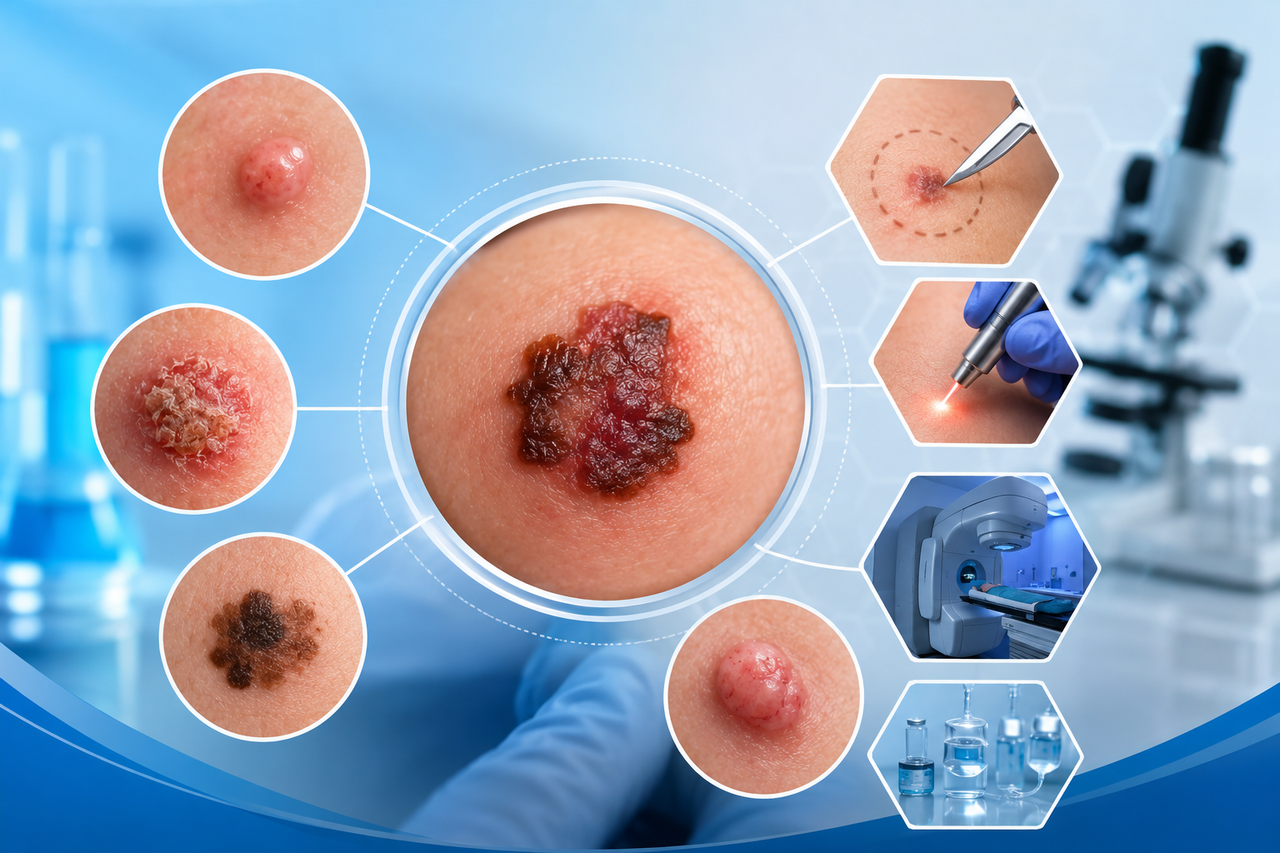
We, being one of the best skin cancer treatment hospitals in kolkata, would like to inform you that there is no one kind of skin cancer. They vary, have their specific features, and act differently. While there are tumors that spread rather slowly, there are tumors that are able to grow rather fast. There are 3 prevalent kinds of skin cancer, namely basal cell carcinoma, squamous cell carcinoma, and melanoma. The growth rate of basal cell carcinoma is very low; however, an individual will be able to detect a shiny nodule or skin lesion. Squamous cell carcinoma can develop as a raised patch of skin, which has an irregular border. At last, melanoma is usually characterized by the change in an already existing mole.
As the above-mentioned skin cancers have different features, doctors can prescribe various options to deal with them.
What can be the role of surgical procedures in skin cancer treatment?
The first type of skin cancer therapy, which doctors may prescribe to their patients, is surgery. The idea is quite clear; excising the lesion and a margin of normal tissue nearby ensures no abnormal cells are left behind.
On some occasions, skin cancers that are particularly small can be surgically excised in a brief procedure, and patients may leave hospital on the same day. For some people, the procedure might end up with just a small dressing, but others might require more time to heal according to the extent and site of the excised area.
Apart from getting rid of the condition, surgery plays a great role in the examination and analysis of the excised tissue.
Are there alternatives to surgical removal?
There exist alternatives to the surgical removal of cancerous spots. For example, certain medicines in a cream base can be used to treat some cases of skin cancer. Such treatments act either by encouraging the body to fight the abnormal cells or by retarding the growth of such cells.
Sometimes, certain types of radiation therapy may be used for treating certain forms of skin cancer. Radiation therapy includes putting a medicine on the affected site and exposing it to radiation. This will ensure the elimination of cancerous cells without damaging the neighboring healthy skin cells.
It all depends on each case since there is no one solution for everyone.
What if skin cancer is deep down in the skin layers?
Skin cancer may sometimes affect other skin layers below its outer layer. At such a point, the course of action taken becomes complex and requires a more comprehensive treatment plan. Radiation therapy, involving energy beams targeting cancerous cells, may be used in some circumstances when surgery fails or further therapy is necessary.
In other cases, medication may be given to kill cancer cells from within the patient's body. Different factors affect what kind of treatment is recommended. Among these factors, the age and physical well-being of the patients are mentioned.
Why should one not ignore skin cancer?
Signs of skin cancer can sometimes go unnoticed. If your skin bleeds easily, the wound refuses to heal or a new change occurs in a mole then such skin problems may be treated at an early stage through proper diagnosis of the same. This doesn’t mean being overly cautious when one experiences any change within their skin. It just means keeping track of anything abnormal and then seeking expert advice where necessary.
While seeking to understand more about the treatments of skin cancer, it should be known that it is not limited to just medical facts alone. This is because cancer treatment is a whole process involving many factors which have to be dealt with individually at different stages. One must know about the options available in order to make better informed decisions about the same. For further information on kidney cancer awareness, click here - punarjanayurveda.com.
REFERENCE LINKS:
https://www.mayoclinic.org/diseases-conditions/skin-cancer/diagnosis-treatment/drc-20377608#:~:text=Photodynamic%20therapy%20is%20a%20two,the%20healthy%20tissue%20around%20it.
https://www.cancer.gov/types/skin/patient/skin-treatment-pdq
https://my.clevelandclinic.org/health/diseases/15818-skin-cancer
https://www.anadolumedicalcenter.com/health-guide/types-of-skin-cancer-diagnosis-and-treatment-processes
https://pmc.ncbi.nlm.nih.gov/articles/PMC8799916/
https://www.curemelanoma.org/patient-eng/melanoma-treatment
https://www.cancerresearch.org/immunotherapy-by-cancer-type/skin-cancer